


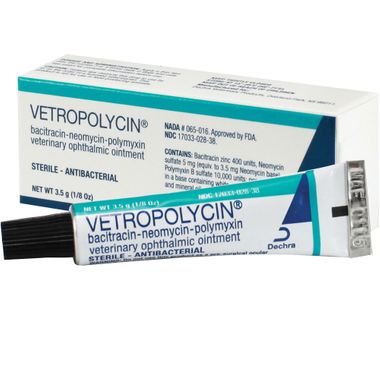

Vetropolycin Opthalmic Ointment is a topical product which is used for the treatment of superficial bacterial infections of the eyelid and conjunctiva in dogs and cats.

Vetropolycin Ophthalmic Ointment 3.5gm
Item# IWM001705
FREE SHIPPING Over $79! * Pet Food & Other Exclusions
1. Select product:
$15.30Reg $19.90
$12.99Reg $16.88
- Description
- Directions
- FAQ
- Reviews
Description
Veterinary Ophthalmic Ointment for the treatment of superficial bacterial infections of the eyelid and conjunctiva in dogs and cats when due to organisms susceptible to the antibiotics contained in the ointment.
Key Benefits
- Bacitracin Zinc, Neomycin Sulfate, Polymyxin B Sulfate
- Broad spectrum of activity against the gram-positive and gram-negative bacteria
How It Works
The polymyxin, neomycin, and bacitracin in Vetropolycin ointment offer broad spectrum protection against gram-negative and gram-positive bacteria associated with superficial conjunctiva and eyelid infections.
Indications
In the treatment of superficial bacterial infections of the eyelid and conjunctiva in dogs and cats when due to organisms susceptible to the antibiotics contained in the ointment. Laboratory tests should be conducted including in vitro culturing and susceptibility tests on samples collected prior to treatment.
Directions
Apply a thin film over the cornea three to four times daily in dogs and cats. The area should be properly cleansed prior to the use of the Vetropolycin (bacitracin-neomycin-polymyxin) veterinary ophthalmic ointment. Foreign bodies, crusted exudates, and debris should be carefully removed.
Caution:
Federal law restricts this drug to use by or on the order of a licensed veterinarian.
Warning:
Do not use this product as a pre-surgical ocular lubricant. Adverse reactions of ocular irritation and corneal ulceration have been reported in association with such use. Serious hypersensitivity (anaphylactic) reactions have been reported in cats within 4 hours of application of antibiotic ophthalmic preparations. Some of these reactions have resulted in death.
Precautions:
Sensitivity to Vetropolycin (bacitracin-neomycin-polymyxin) veterinary ophthalmic ointment is rare; however, if a reaction occurs, discontinue use of the preparation. As with any antibiotic preparation, prolonged use may result in the overgrowth of nonsusceptible organisms including fungi. Appropriate measures should be taken if this occurs. If infection does not respond to treatment in two or three days, the diagnosis and therapy should be re-evaluated. Care should be taken not to contaminate the applicator tip of the tube during the application of the preparation. Do not allow the applicator tip to come in contact with any tissue.
Adverse Reactions:
Itching, burning or inflammation may occur in animals sensitive to the product. Discontinue use in such cases. For a copy of the Material Safety Data Sheet (MSDS), or to report adverse reactions, call Dechra Veterinary Products at (866) 933-2472.
Storage:
Store at 15°-25°C (59°-77°F).
FAQ
The polymyxin, neomycin, and bacitracin in Vetropolycin ointment offer broad spectrum protection against gram-negative and gram-positive bacteria associated with superficial conjunctiva and eyelid infections.
Vetropolycin use should be discontinued if your pet exhibits sensitivities to the medication, such as:
- Inflammation
- Burning
- Itching
- While side effects are rare, you should stop administering Vetropolycin to your pet if any reactions are noted.
- Keep out of the reach of children.
- Avoid allowing the tip of the applicator to come into contact with any tissue.
- Do not contaminate the tip of the applicator during application.
- Re-evaluate therapy and diagnosis with your veterinarian if the infection does not respond to the medication within 2-3 days.
- Prolonged use could cause overgrowth of non-susceptible organisms, including fungi. If this occurs, take appropriate measures.
- Do not use as a pre-surgical treatment.
In case of overdose, contact your closest emergency pet hospital
